What is Sana commerce and how does it work within ERP systems
Sana commerce is an e-commerce platform that runs entirely on your ERP system. Instead of a separate database, the webshop pulls all data directly from systems such as Dynamic 365 and SAP. This means product information, prices and customer data are always synchronized with your ERP.
This creates clarity and prevents duplicate data. At the same time, it lays the foundation for a webshop that is completely dependent on that same ERP. As long as your processes remain simple, that works well. But as soon as you want to optimize or adjust more, you notice that this dependency limits your room to maneuver.
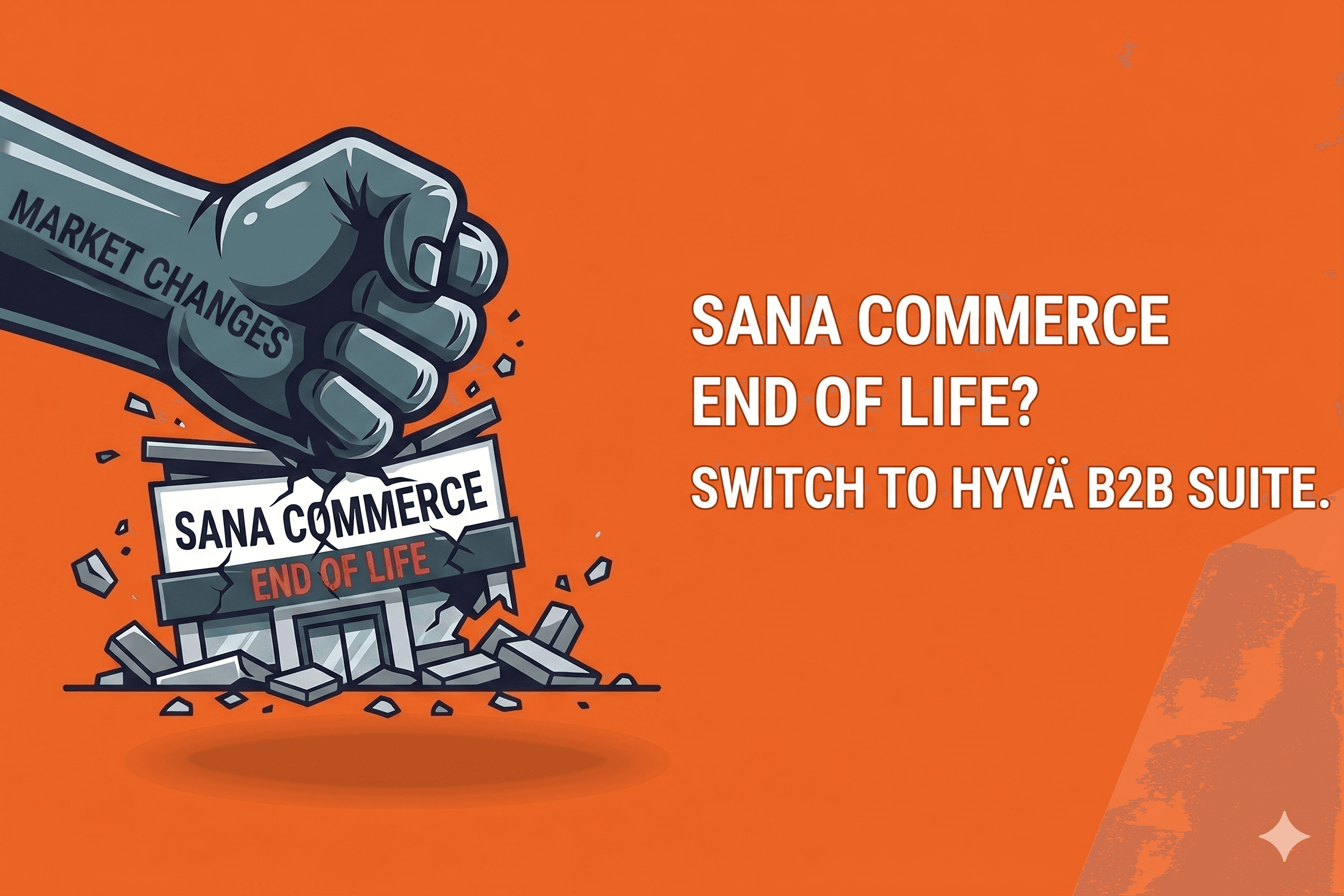
The impact of end of life on Sana commerce
The end of life of Sana commerce means that the SaaS solution will no longer be further developed in the long term and support will decrease. This makes the platform less future-proof for organizations that want to keep growing. Especially in a market where e-commerce is constantly changing, this causes existing limitations to become visible faster and weigh more heavily in day-to-day operations. In this phase, many organizations look at solutions such as Hyvä B2B, because it offers more flexibility to set up a B2B webshop that better aligns with growth and changing customer needs.
The dependency on ERP within Sana commerce
In practice, you quickly notice how strongly that dependency affects things. If you want to change something in your webshop, you often have to go back to the ERP first. That makes it harder to switch quickly or test new ideas.
Especially for organizations working with extensive structures in SAP or Dynamic 365, you see that changes take time. As a result, your webshop does not always follow your commercial strategy, but rather the technical possibilities of your ERP. This is often the first sign that the platform no longer fits well with the phase your organization is in.
Limited flexibility in design and user experience
A webshop is more than an ordering system. It is an environment in which customers must be able to work quickly and without errors. Think of navigation, search functions and an ordering process.
Within Sana commerce, you notice that this freedom is limited. The front-end is strongly linked to the ERP, which gives you less room to fully tailor the user experience to your liking. This becomes especially visible when you want to optimize for conversion or different customer groups. Particularly in a growth phase in which you want to focus more on usability and performance, this can become a limitation.
Technical and functional restrictions within a saas solution
As a SaaS solution, Sana commerce offers convenience in management, but the trade-off is that you have less influence over the technology. The development of the platform lies with the supplier and follows a fixed roadmap.
This means you do not always decide yourself when and how you implement new functionality. If you have specific wishes or want to switch faster, you depend on what is available. For organizations that want to keep developing and optimizing, that is often the point at which they start looking further.
Limitations in B2B workflows and complexity
B2B e-commerce requires flexibility in processes. You work with customer-specific prices, different catalogs and often also with approval flows or complex ordering structures.
Sana commerce supports part of these B2B workflows, but once your processes deviate from the standard, it becomes more difficult. Adjustments often have to be routed through the ERP, making changes more complex. As your organization grows and processes become more specific, you notice that the platform moves with you less well.
Implementation and costs in practice
The choice of a platform goes beyond functionality alone. Implementation and further development also play a major role. Because Sana commerce is so closely connected to the ERP, implementation requires good alignment between systems.
This means time and capacity are needed for setup, testing and optimization. In addition, there are costs that are not always immediately visible, such as adjustments in the ERP and ongoing support. Many organizations only notice this when they grow further and want to change more than initially expected.
When Sana commerce does work
There are also situations in which Sana commerce fits well. If you work with relatively simple processes and rely heavily on your ERP, then the direct connection provides clarity and peace of mind.
As long as you have little need for flexibility in the webshop and processes are largely standardized, the platform can function just fine. The limitations only become visible when your organization takes the next step and your webshop has to grow along with it.
The solution from Epartment
For many B2B companies, there comes a point when flexibility becomes more important. This often happens when organizations want to grow, enter new markets or further digitize their processes.
In this phase, many organizations look at solutions such as Magento in combination with Hyvä B2B, because this provides more freedom in design, performance and setting up complex B2B processes without direct dependency on the ERP. Epartment guides companies through this transition and helps set up an e-commerce environment in which systems work together via an integration layer, so that the webshop better aligns with the organization's growth and ambitions.
When you notice that your webshop is starting to limit your growth, it is important to look at the foundation again. Epartment develops B2B webshops on Magento that align with your pricing structures, catalogs and ordering processes. With Conneqt, ERP and PIM systems are directly connected and with CoreBox the environment remains stable and fast.
Where can I request a demo for an e-commerce solution aimed at wholesalers?
Many specialized parties offer demos for wholesalers. If you want to see how a solution aligns with your processes, it is wise to look at a party with experience in your industry. For example, see how a wholesale webshop is set up and which functionalities are involved.